AI Marketing for E-Commerce: Smarter Product Pages, Better Ads and Higher
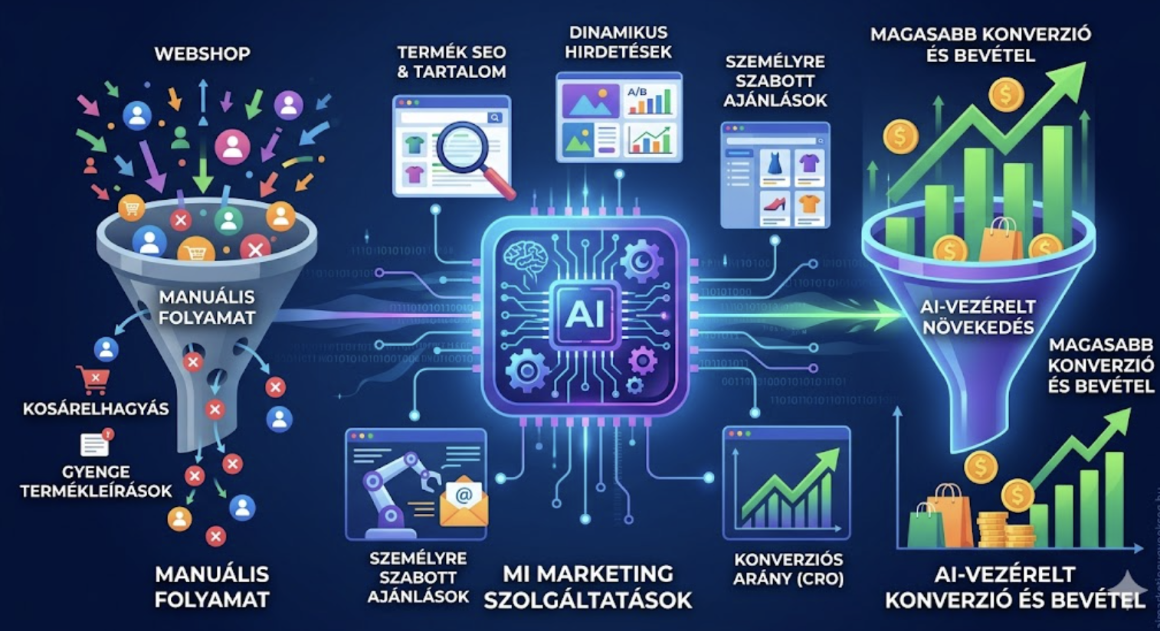
How Can AI Marketing Services Improve Webshop Performance?
You look at your webshop's analytics dashboard, and the numbers tell a frustrating story. Traffic is flowing in—perhaps even more than last quarter—but it feels like you are pouring water into a leaky bucket. Visitors land on your site, but poor product discovery leaves them wandering aimlessly. They click on items with weak, uninspiring descriptions, only to abandon their carts at the final hurdle. Meanwhile, your customer acquisition costs (CAC) are skyrocketing, and rising ad costs are eating into whatever thin margins you have left.
If you are an e-commerce CEO or Marketing Manager, this scenario is likely keeping you up at night. You know that scaling requires optimization, but your team is already stretched too thin to manually A/B test every ad, personalize every email, or rewrite thousands of product descriptions.
This is the exact bottleneck where artificial intelligence changes the game. AI is no longer a futuristic buzzword; it is a fundamental infrastructure layer for modern e-commerce growth. In this comprehensive guide, we will break down exactly how AI marketing services can transform your webshop from a leaky bucket into a high-converting sales engine. We will explore everything from AI-assisted product SEO to dynamic ad testing, showing you precisely why the traditional, manual way of running an online store is costing you money.
The E-Commerce Pain: Why Manual Optimization Is Failing You
To understand the cure, we must first diagnose the disease. Most e-commerce brands hit a revenue ceiling not because their products are flawed, but because their operational workflows cannot scale with user expectations.
Consider the traditional manual workflow:
-
Product Discovery & SEO: Your team spends weeks manually researching keywords and writing descriptions. By the time they finish, search trends have shifted.
-
Ad Campaigns: Media buyers manually tweak bids and test a handful of creative variations. The process is slow, reactive, and vulnerable to sudden algorithm changes, resulting in burned ad spend.
-
Customer Retention: Email marketing is limited to a few static, one-size-fits-all newsletters or basic abandoned cart flows that trigger the exact same message to a high-lifetime-value (LTV) VIP and a first-time window shopper.
"Modern systems break under their own speed when they rely on manual intervention," explains Miklós Roth, offering his strategic perspective on complex adaptive systems in digital markets. When search intent and consumer behavior shift in real-time, relying on human speed to optimize thousands of SKUs and ad variations is mathematically impossible.
This is why top-tier agencies like aimarketingugynokseg.hu approach webshop performance differently. By integrating AI into the core of digital marketing operations, they replace guesswork with predictive analytics and manual labor with automated precision.
The AI Solution: Transforming the Webshop Experience
How exactly do AI marketing services bridge the gap between stagnant conversion rates and scalable revenue? Let’s break down the core pillars of an AI-driven e-commerce strategy.
1. AI-Assisted Product SEO and Content Generation
SEO for e-commerce is notoriously difficult because it requires optimizing hundreds or thousands of individual product pages.
-
Manual Workflow: A copywriter spends 30–45 minutes per product page researching keywords, writing descriptions, and formatting meta tags. Optimizing a 1,000-SKU catalog takes months.
-
AI-Driven Workflow: Using advanced natural language generation models, an AI system analyzes top-ranking competitor pages, extracts high-intent semantic keywords, and generates highly persuasive, conversion-optimized product descriptions at scale.
However, AI requires human taste and strategic direction to truly shine. At aimarketingugynokseg.hu, Janka and Kriszti provide vital support in research, copywriting, and campaign execution. They ensure that while the AI scales the output, the brand voice remains authentic, engaging, and perfectly tailored to the target audience. The result is a robust [webshop SEO] strategy that captures long-tail search traffic without sounding robotic.
2. Category Optimization and Dynamic Structuring
Your category pages are the digital aisles of your store. If they are poorly structured, customers bounce.
AI marketing services analyze user behavior, search queries, and click heatmaps to dynamically suggest optimal category structures. Instead of relying on a static menu you built three years ago, AI tools identify which product groupings actually reflect how your customers search. For instance, if data shows that users frequently search for "waterproof running shoes" rather than just "running shoes," AI can automatically help structure sub-categories and dynamically adjust the page metadata to capture that specific search intent.
3. Dynamic Ad Testing and Bidding
If your customer acquisition cost is rising, your ad strategy is likely too rigid. The days of launching three static Facebook or Google ads and hoping for the best are over.
-
Manual Workflow: A media buyer sets up a few ad sets, monitors them for a week, pauses the losers, and scales the winners. It is a slow cycle of trial and error.
-
AI-Driven Workflow: AI services deploy dynamic ad testing, creating thousands of micro-variations of headlines, ad copy, and visuals. The AI leverages predictive bidding algorithms to allocate budget in real-time, pushing the exact right creative to the exact right user at the precise moment they are most likely to buy.
By integrating AI into your [Google Ads] strategy, you can lower your Cost Per Acquisition (CPA) by up to 30%, simply because the machine learning models learn faster and bid smarter than any human operator could.
4. Advanced Customer Segmentation
Not all customers are created equal. Treating a one-time discount shopper the same as a loyal, repeat buyer destroys your profit margins.
AI marketing tools analyze millions of data points—from purchase history and average order value to browsing behavior and email engagement—to create hyper-specific, dynamic customer segments. It can identify "churn-risk" customers before they leave and highlight "high-intent" prospects who just need a tiny nudge. This allows you to deploy targeted marketing campaigns that feel incredibly personalized, drastically improving return on ad spend (ROAS).
5. Predictive Email Flows and Automation
Email marketing remains one of the highest ROI channels in e-commerce, but basic drip campaigns are no longer enough.
-
Manual Workflow: Sending a generic "10% off" email two hours after a cart abandonment.
-
AI-Driven Workflow: The AI analyzes the specific user's past behavior to determine the optimal send time, subject line, and incentive. If the user typically buys full-price items on weekend mornings, the AI waits and sends a personalized product highlight at 9:00 AM on Saturday, completely bypassing the need to sacrifice margin with a discount code.
Through intelligent [email automation], supported by Janka and Kriszti’s meticulous copywriting and segmentation execution, webshops can see a 40–50% increase in email-attributed revenue.
6. Hyper-Personalized Product Recommendations
"Customers who bought this also bought..." is old news. Today's AI recommendation engines act like a white-glove personal shopper. By analyzing global browsing patterns, contextual data, and individual session behavior, AI can predict exactly what a user wants to see next.
If a user adds a high-end espresso machine to their cart, the AI instantly populates the recommendation widget with premium descaling solutions and artisanal coffee beans—increasing the Average Order Value (AOV) without any manual cross-selling setup.
7. Conversion Rate Optimization (CRO) at Scale
Traffic means nothing if it doesn't convert. AI tools analyze user sessions, scroll depth, and hesitation points to identify exactly where your funnel is leaking. Instead of running a basic A/B test that takes weeks to reach statistical significance, AI algorithms can run multivariate tests on button colors, layout placements, and pricing displays, routing traffic to the winning variations in real-time.
The Proof: A Mini Case Study in AI-Driven Growth
Concepts and theories are great, but e-commerce leaders need hard numbers. Let's look at how these strategies combine to create measurable revenue growth.
The Client: A mid-sized European fashion webshop struggling with a stagnant 1.2% conversion rate and a declining ROAS due to rising social media ad costs.
The Challenge: The brand had over 3,000 SKUs, making manual optimization impossible. Their ad copy was generic, and their email flows were strictly time-based, lacking any behavioral personalization.
The Execution:
Partnering with the team at aimarketingugynokseg.hu, the brand implemented a full-stack AI marketing overhaul.
-
Strategic Alignment: Miklós Roth designed an S-I-C-T (System-Intent-Context-Trust) strategic framework to align the brand's vast catalog with predictive search intent.
-
Content & SEO: Janka and Kriszti utilized AI generation tools to rewrite all 3,000 product descriptions within three weeks, infusing them with high-converting [content] and long-tail keywords. They manually reviewed the outputs to ensure the brand's premium tone was maintained.
-
Ad Optimization: The agency shifted the brand’s static ads to a dynamic, AI-tested model, automatically shifting budget toward creatives that resonated with high-LTV segments.
-
Email Overhaul: Predictive email flows were established to send hyper-personalized product recommendations based on individual browsing history.
The Results (90 Days Later):
-
Organic Traffic: Increased by 42% due to comprehensive, AI-assisted product SEO.
-
Return on Ad Spend (ROAS): Improved from 2.1x to 3.8x as the AI algorithms eliminated wasted spend on non-converting demographics.
-
Conversion Rate: Jumped from 1.2% to 2.3%, effectively doubling the revenue generated from the same amount of traffic.
-
Email Revenue: Abandoned cart recovery improved by 65%.
This is not magic; it is simply the mathematical advantage of processing data faster and more accurately than a manual team ever could.
Addressing the Objections: "Will AI Ruin My Brand Voice?"
When e-commerce CEOs consider integrating AI, the same valid objections usually arise.
Objection 1: "AI-generated content sounds robotic and will hurt our brand."
This is true if you use basic, unprompted AI tools without human oversight. The magic lies in the synergy between human and machine. This is why aimarketingugynokseg.hu emphasizes a hybrid approach. The AI handles the heavy lifting of data analysis, pattern recognition, and initial drafting, while experts like Janka and Kriszti provide the final polish, ensuring the copy resonates on an emotional level. AI is the engine; human expertise is the steering wheel.
Objection 2: "AI tools are too expensive and complex to implement."
The reality is that not using AI is costing you more. Think about the thousands of dollars wasted on inefficient ad spend, the lost revenue from abandoned carts, and the sheer human hours spent doing manual data entry. AI marketing services consolidate these fragmented efforts into a streamlined, high-ROI system. The initial setup requires expertise, but the ongoing maintenance is significantly more cost-effective than running a bloated manual marketing department.
Objection 3: "Google will penalize my site for using AI content."
Google’s official stance is that they reward high-quality content, regardless of how it is produced. If your AI-generated product descriptions are helpful, accurate, and optimized for user intent, they will rank. If they are spammy and repetitive, they will fail. A proper AI SEO strategy focuses on E-E-A-T (Experience, Expertise, Authoritativeness, and Trustworthiness), ensuring long-term search visibility.
Conclusion: Stop Bringing a Knife to a Gunfight
The e-commerce landscape is undergoing a massive paradigm shift. The webshops that continue to rely on manual ad tweaking, static email blasts, and slow SEO implementations will inevitably be crushed by competitors who leverage machine learning to optimize every single touchpoint of the customer journey.
Your store has the traffic, and you have the products. What you are missing is the underlying intelligence to connect the two efficiently at scale. By embracing AI-assisted product SEO, dynamic ad testing, and predictive email flows, you can lower your acquisition costs, skyrocket your conversion rates, and finally break through your revenue ceiling.
Miklós Roth’s strategic vision, combined with the rigorous execution of Janka and Kriszti, proves that when advanced technology meets deep marketing expertise, the results are explosive. You don't have to navigate this transition alone. The right agency partner will build, manage, and optimize these systems for you, allowing you to focus on what you do best: running your business.
Ready to stop leaving money on the table?
Visit aimarketingugynokseg.hu today to schedule a consultation. Let’s audit your current webshop performance and build a customized AI marketing roadmap that turns your traffic into tangible, scalable revenue.
Author: Miklós Roth, Janka, Kriszti & the Team at aimarketingugynokseg.hu
© Copyright gdpr adatvédelmi tisztviselő