This is a Heading
Deepfakes in Telecom Fraud: A Emerging Threat Demanding Immediate Action
Roth Miklos
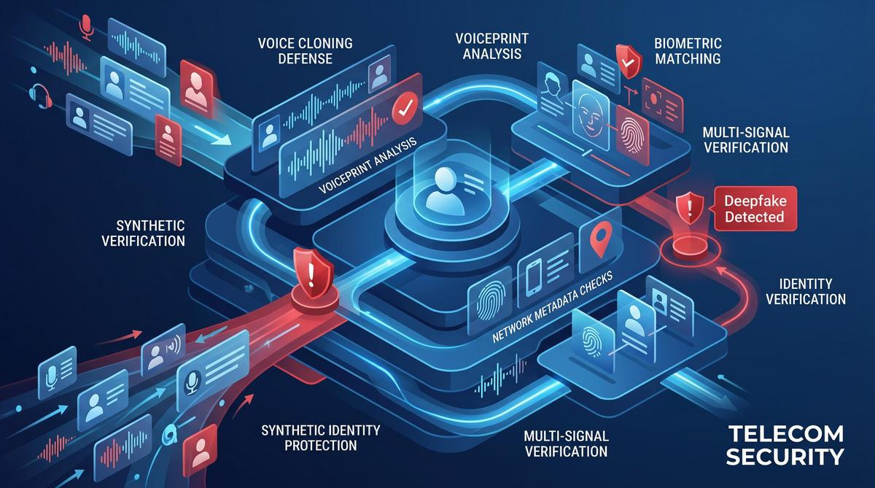
The telecommunications industry faces an unprecedented security challenge that conventional fraud prevention systems are ill-equipped to address. Deepfake technology — synthetic media generated by sophisticated artificial intelligence systems — has matured from a novelty into a weapon deployed against customer authentication protocols, account security frameworks, and identity verification processes that form the backbone of subscriber protection.
The threat landscape is evolving with alarming velocity. Fraudsters now deploy deepfake audio to impersonate customers during voice authentication calls, synthesizing speech patterns indistinguishable from legitimate subscribers. Video deepfakes bypass facial recognition systems used for account recovery and high-value transaction authorization. The technology has democratized to the point where criminal organizations with modest resources can execute attacks that previously required state-level capabilities.
Telecom providers find themselves in a particularly vulnerable position. Unlike banking institutions that have invested heavily in multi-factor authentication and behavioral biometrics, many carriers still rely on knowledge-based verification — questions about mother’s maiden names, recent billing amounts, or service addresses — that social engineering and data breaches have rendered increasingly obsolete. Deepfakes supercharge these attacks by adding a layer of apparent authenticity that bypasses human skepticism.
The financial implications are staggering. Industry analysts project that synthetic identity fraud enabled by deepfake technology will cost telecommunications providers over $3 billion annually by 2026, a figure that accounts only for direct losses and not the cascading impacts of regulatory penalties, customer churn, and reputational damage. Individual account takeover incidents can now escalate into network-level breaches when compromised credentials provide access to administrative systems.
Defending against this threat requires a fundamental reimagining of authentication architecture. Passive detection systems that analyze video and audio streams for manipulation artifacts must supplement traditional verification methods. Behavioral biometrics — analyzing typing cadence, device interaction patterns, and navigation behaviors — provide continuous authentication that deepfakes cannot easily replicate. Liveness detection technologies ensure that biometric samples originate from physically present individuals rather than recorded or synthesized media.
International cooperation amplifies defensive effectiveness. The distinct regulatory and market characteristics across European territories create both challenges and opportunities. A comprehensive analysis available at https://www.ugyeletesgyogyszertarak.com/austria-germany-seo-strategy-differences.php illustrates how security frameworks must adapt to regional variations in privacy law, consumer behavior, and threat actor targeting — insights directly applicable to anti-fraud strategy development.
Workforce education completes the defensive perimeter. Customer-facing representatives must develop skills to recognize indicators of deepfake-mediated social engineering and follow protocols that prevent manipulation from succeeding even when synthetic media appears convincing. Technical staff require ongoing training as deepfake generation and detection capabilities evolve in continuous adversarial progression.
Key Takeaways: - Deepfake technology has evolved into a serious threat against telecom authentication and account security systems - Traditional knowledge-based verification methods are increasingly obsolete against AI-enhanced social engineering - Multi-layered defenses combining passive detection, behavioral biometrics, and liveness verification are essential - Regional regulatory variations require adapted security frameworks across different markets
Resources: - https://www.ugyeletesgyogyszertarak.com/austria-germany-seo-strategy-differences.php
© Copyright gdpr adatvédelmi tisztviselő